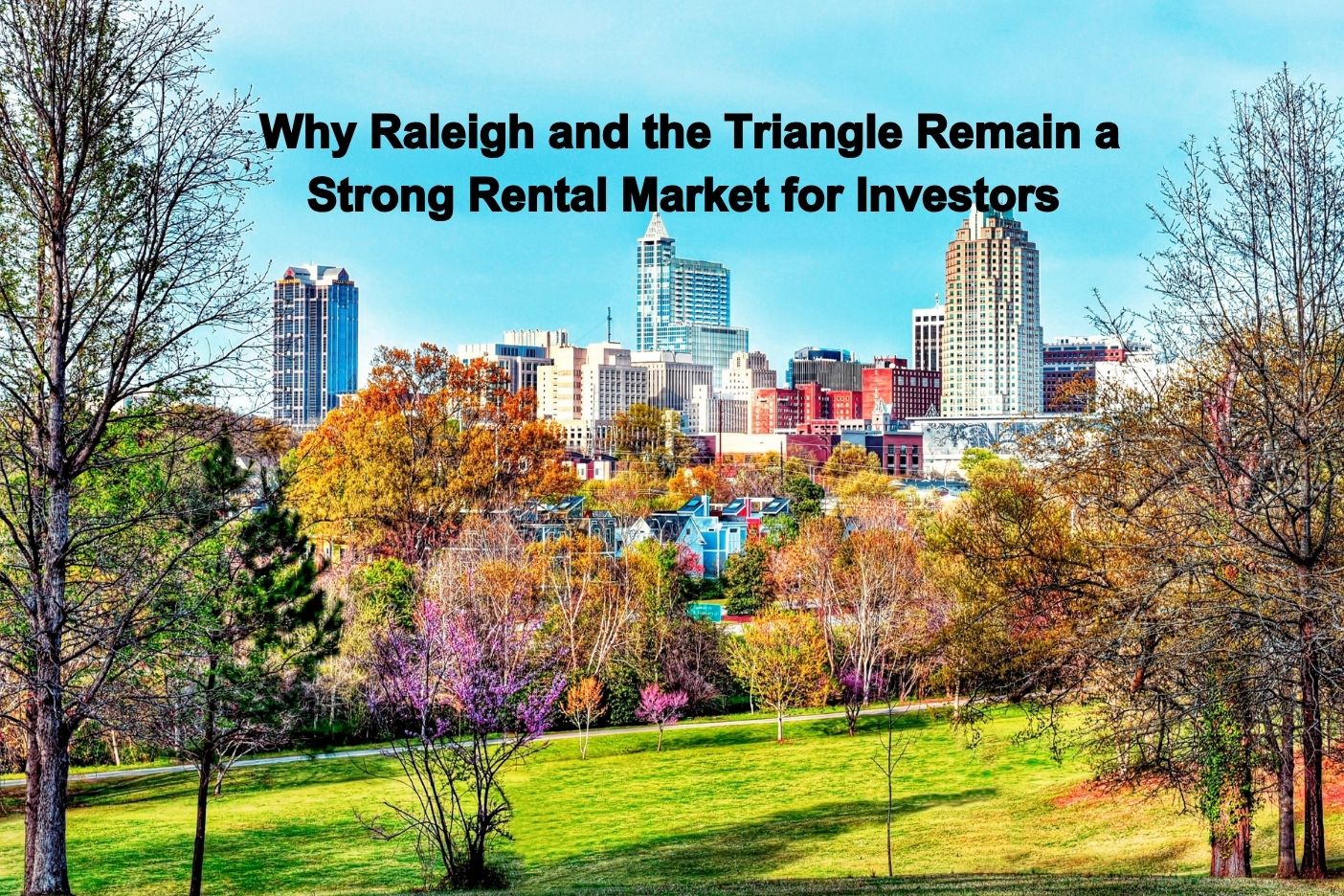
Why Raleigh and the Triangle Remain a Strong Rental Market for Investors
Updated June 2026 (originally published April 14, 2026)
Over the past several years, North Carolina has emerged as one of the most powerful magnets for population growth in the country. According to the latest estimates from the U.S. Census Bureau, the state continues to rank among the fastest-growing in the nation, supported by sustained inbound migration and long-term economic expansion.
Yet many rental property owners and investors find themselves confused by recent housing headlines — particularly stories highlighting rent concessions, slowing rent growth, or increased competition in parts of the Sunbelt.
For long-term investors, this environment can feel contradictory. But North Carolina’s growth story represents more than a demographic trend — it remains a structural demand driver with direct implications for occupancy stability, rental demand, and long-term investment performance.
Within North Carolina, the Raleigh-Durham region continues to stand out.
North Carolina’s Growth Is Not a Short-Term Trend
North Carolina consistently ranks among the top states for inbound domestic migration. Households continue relocating from higher-cost markets in search of:
Greater housing affordability
Economic opportunity
Lifestyle advantages
Long-term stability
This migration flow supports steady household formation — one of the most durable drivers of rental housing demand.
More households require more places to live.
For long-term investors, this reinforces Raleigh’s long-term investment fundamentals, rather than short-term market fluctuations.
Raleigh-Durham: Demand Supported by Economic Fundamentals
Raleigh’s strength is anchored in a diversified and resilient economic base, including:
Technology and life sciences
Healthcare and research
Higher education
Government and professional services
Employment growth across the Triangle continues attracting highly skilled workers, reinforcing both housing demand and rental absorption.
Job growth fuels household formation. Household formation fuels rental demand.
Migration’s Direct Impact on the Rental Market
Many incoming residents do not purchase immediately. Instead, they often:
Rent while learning the area
Delay buying due to mortgage rates
Prioritize flexibility
Relocate for career opportunities
This behavior supports consistent demand for:
Single-family residences
Townhomes
Suburban rental properties
Single-Family Rental Demand Remains Structurally Supported
Unlike large apartment communities that deliver hundreds of units at once, single-family rental supply expands gradually. This structural difference contributes to long-term market stability.
Research published by Cotality’s Single-Family Rent Index (SFRI) shows that single-family rental housing continues benefiting from:
Limited inventory growth
Durable tenant demand
Affordability barriers to homeownership
Zillow Data Reflects Rent Stabilization — Not Weakness
Market data from the Zillow Observed Rent Index (ZORI) shows Raleigh rents experiencing modest year-over-year adjustments, consistent with a normalization cycle following the extraordinary post-pandemic surge.
Importantly: Rent moderation is a characteristic of a maturing market — not a failing one.
National Rent Growth Has Slowed — and That’s Normal
Cotality's Single-Family Rent Index has now tracked this slower growth pattern for the better part of a year — and the latest data confirms it's holding steady rather than continuing to fall off a cliff.
As of April 2026:
- U.S. single-family rents increased 1.4% year over year
- That's down from 2.8% growth in April 2025, but in line with the pace the market has held since late 2025
- Since fall 2025, annual rent growth has remained in a narrow 1%–1.5% band, signaling the market has settled into a steadier phase after the sharper deceleration seen earlier in the cycle
- Growth continues to diverge by segment and region, with higher-priced rentals still outperforming lower-priced homes
Cotality's economists describe this as the market finding its footing — not falling apart. Rents nationally remain roughly 27% higher than they were five years ago, even with growth now running near 15-year lows.
As Senior Principal Economist Molly Boesel explains, this slowdown reflects:
✔ A broad-based cooling after years of rapid increases
✔ Normalization across price tiers
✔ Convergence toward sustainable growth levels
This is best understood as market stabilization, not deterioration.
What This Means for Raleigh Investors
Raleigh is not isolated from national housing trends.
Like most U.S. metros, the Triangle has transitioned from the extraordinary rent acceleration of 2021–2022 into a more balanced environment characterized by:
Measured rent growth
Longer leasing timelines
Increased pricing discipline
Greater tenant choice
This shift is best described as:
Normalization — not weakness.
Raleigh continues benefiting from:
Population growth
Employer expansion
Strong household formation
Durable demand for long-term rental housing
For disciplined investors, normalization phases often create more predictable operating conditions.
What About the “Free Rent” Headlines?
Investors following national housing news may have seen reports of increased rent concessions.
In Raleigh-Durham, these incentives are primarily concentrated in newly delivered Class A apartment communities, particularly those competing during initial lease-up.
Key distinctions:
Concessions are largely limited to large multifamily properties
Most single-family rental homes are not competing with months of free rent
Rental homes continue benefiting from migration and affordability dynamics
MasterKey Portfolio Data: What We’re Seeing in the Raleigh Rental Market
While national headlines provide broad context, real insight comes from actual portfolio performance.
Across MasterKey-managed rental properties in the Raleigh–Durham market, we’re seeing:
✔️ Leasing timelines have normalized
✔️ Occupancy levels remain strong
✔️ Renewal activity remains consistent
✔️ Rent growth has moderated
April 2026 MasterKey Portfolio Metrics
Average Days to Lease: 24 days
Portfolio Occupancy: 98%
Lease Renewal Rate: 90%
Average Renewal Adjustment: +2%-5%
Source: MasterKey Property Management internal portfolio data
June 2026 MasterKey Portfolio Metrics
Average Days to Lease: 21 days
Portfolio Occupancy: 96%
Lease Renewal Rate: 89%
Average Renewal Adjustment: +2%-5%
Source: MasterKey Property Management internal portfolio data
“Across our portfolio, we’re not seeing demand decline—we’re seeing normalization. Well-positioned properties continue to perform.”
Robert Dell’Osso
CEO, MasterKey Property Management
What This Data Tells Us
Most market reports rely on lagging indicators. This data reflects real-time performance across actively managed rental properties.
The takeaway is clear:
✔️ Demand remains intact
✔️ Properties are still leasing efficiently
✔️ Occupancy continues to hold at strong levels
✔️ The market is stabilizing—not weakening
Affordability Pressures Continue to Support Rentals
Higher mortgage rates and increased home purchase costs continue reshaping housing decisions.
Cotality.com research highlights that affordability constraints are encouraging many households to:
Remain renters longer
Delay purchase decisions
Seek flexibility
This dynamic supports:
Stable occupancy
Longer tenancy durations
Continued rental demand
It's not just mortgage rates pushing people toward renting — home prices themselves have stalled. Cotality's Home Price Index shows national home values up just 0.3% year-over-year as of April 2026, with prices essentially flat since the start of the year. In several major metros, prices are actually declining. For would-be buyers, that removes one of the usual incentives to rush into a purchase — and reinforces why many are choosing to stay in the rental market longer.
A Maturing Market Creates Healthier Investment Conditions
Raleigh is evolving into a more sustainable phase defined by:
Measured rent growth
Predictable leasing cycles
Greater pricing discipline
Increased tenant choice
For long-term investors, this stability reduces volatility and rewards disciplined ownership strategies.
What This Means for Long-Term Rental Investors
Raleigh continues offering:
Durable Demand Drivers
Supported by population and job growth.
Broad Tenant Pool
Relocating professionals, families, and long-term residents.
Stability Over Volatility
Performance increasingly shaped by disciplined pricing and professional management.
Why Execution Matters More in Normalized Markets
Investor success today is driven by:
Accurate pricing
Minimizing vacancy
Tenant retention
Property condition
Responsive management
This is where experienced operators consistently outperform.
The MasterKey Perspective
At MasterKey Property Management, we focus exclusively on long-term residential rentals across the Raleigh-Durham region.
We continue seeing:
Strong relocation-driven demand
Healthy leasing activity
High interest in suburban rental homes
Owners benefiting from occupancy stability
Even as rent growth normalizes, Raleigh’s long-term fundamentals remain among the strongest in North Carolina.
Looking Ahead
No market moves in a straight line.
But Raleigh’s trajectory continues supported by:
Population growth
Employer expansion
Household formation
Sustained rental demand
For investors focused on long-term stability and disciplined performance, Raleigh remains a market deserving serious consideration.
Frequently Asked Questions About the Raleigh Rental Market
Is the Raleigh rental market slowing down?
Why are some properties taking longer to rent in Raleigh?
Are rent concessions affecting single-family rentals?
Is Raleigh still a good market for rental property investment?
What type of rental properties perform best in the Triangle?
What matters most for rental performance in today’s market?
Should investors be concerned about rent growth slowing?
Want a property manager who knows how to protect your investment and boost your ROI?
Let’s talk about how MasterKey’s proven expertise can help you
manage smarter and earn more—without the stress.
📞 919.655.3950