
Rental Pricing: How to Maximize Rental Income and Reduce Vacancy
How Much Can You Get for Your Rental Property? And Why Getting the Price Right from the Start Makes a Difference.
Pricing a rental property correctly plays a critical role in how quickly it leases—and how much an owner ultimately earns.
What You’ll Learn in This Article
- → How pricing impacts leasing speed and total rental income
- → The hidden cost of overpricing—and how it affects time on market
- → Why the first 10–14 days are critical to leasing success
- → How data-driven analysis determines the right pricing range
- → How pricing fits into a broader strategy that drives stronger results
When a Property Is Priced Correctly
When pricing is aligned with market demand and supported by strong presentation and marketing, a property:
- Generates strong interest within the first few days
- Attracts more qualified applicants
- Reduces time on market
- Minimizes vacancy loss
- Creates competitive urgency among renters
- Protects long-term asset performance
When a Property Is Priced Too High
Overpricing—even slightly—creates a ripple effect:
- Fewer showings and lower online engagement
- Longer days on market
- Reduced perceived value compared to competing properties
- Increased likelihood of price reductions
- Greater vacancy loss
- Higher risk of accepting less-qualified applicants
What most owners don’t realize is that a delayed lease often costs more than a slightly lower starting price.
Get a Free Rental Analysis delivered directly to your email.
Expert Insight
“The right rental price is not about testing the market—it’s about entering the market correctly from day one so you lease faster, reduce vacancy, and protect your long-term return.”
Robert Dell’Osso
CEO, MasterKey Property Management
The Critical First 10–14 Days
The first 10–14 days on the market are the most important. This is where pricing, presentation, and market timing all come together.
This is when your property gets:
- The highest visibility on listing platforms
- The most inquiries and showing requests
- The strongest pool of qualified applicants
If a property is overpriced during this window, it misses peak demand. Once that happens, the listing becomes “stale” in the eyes of renters.
Even after a price reduction, it can take significantly longer to regain traction—often leading to extended vacancy and lost income.
Don’t leave money on the table—or lose weeks of rent
Pricing your property correctly from day one is the difference between fast leasing and costly vacancy.
Call us to discuss your goals - 919 453 5010
The Real Cost of Overpricing
Consider a simple example:
- Market-supported rent: $2,000/month
- Listed at: $2,150/month
- Result: Property sits an extra 3–4 weeks
That delay can cost $1,500–$2,000+ in lost rent—far outweighing the extra $150/month the owner hoped to achieve.
We see this play out regularly. In one recent case, a pricing adjustment reduced vacancy time and improved overall return—despite a lower starting price. Read the full case study
This is why pricing is not about chasing the highest monthly number—it’s about maximizing total return over time.
How We Determine the Right Price
At MasterKey Property Management, pricing decisions are not made in isolation—they’re based on real-time data and how your property compares within the current market.
We use a data-driven approach to position your property competitively in real-time market conditions.
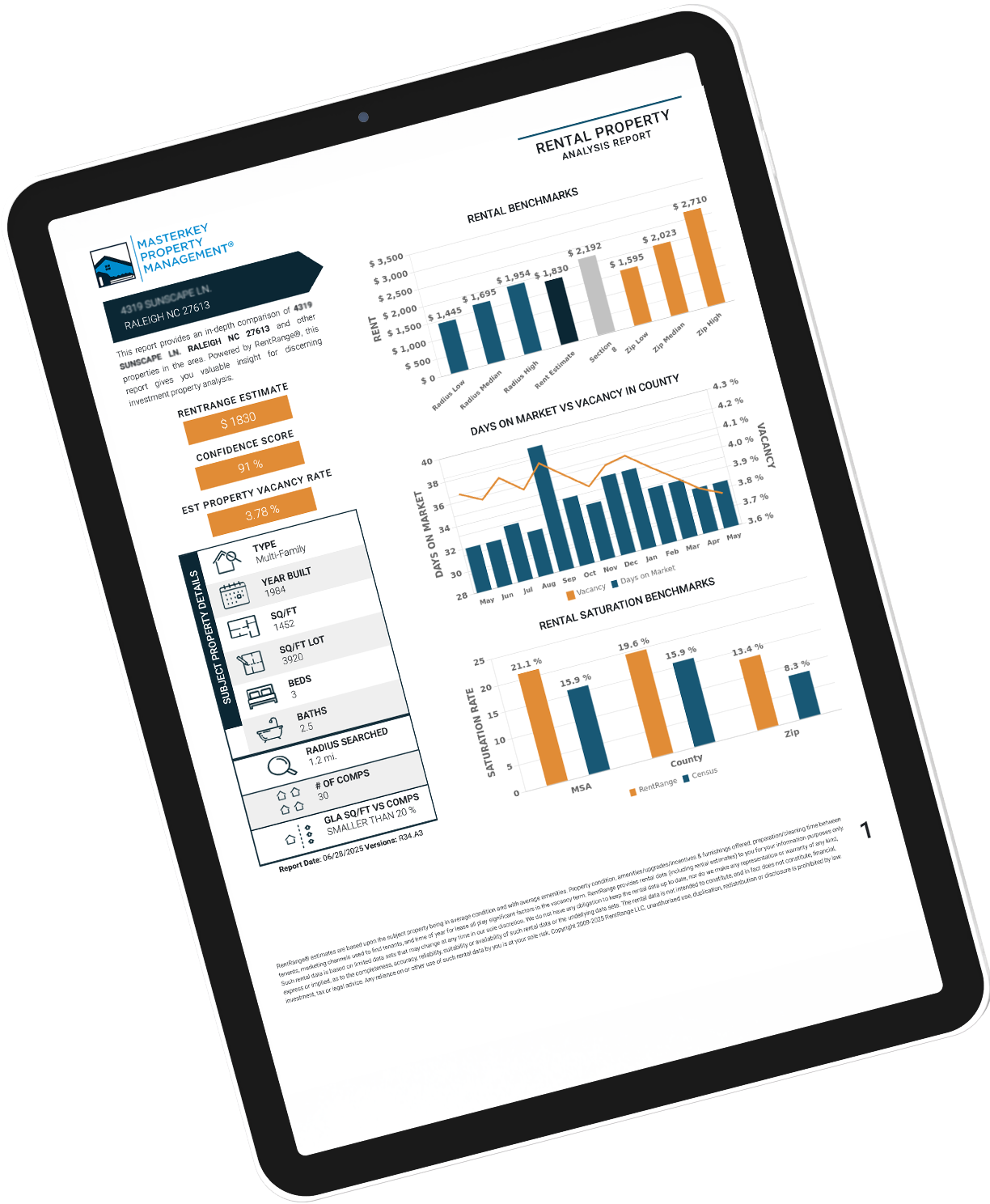
Our Rental Analysis (RA)
Our Rental Analysis evaluates:
- Current active competition
- Recently leased comparable properties
- Days on market trends
- Seasonal demand shifts
- Property condition and features
- Location-specific demand
- Overall rental market velocity
This gives us a clear picture of what renters are actually choosing—not just what properties are listed for. Get a Free Rental Analysis now!
Why We Provide a Pricing Range
We provide a recommended range—not a single number—because rental pricing is influenced by real-time market variables.
- Competing properties entering or leaving the market
- Changes in demand
- Property condition
- Timing and seasonality
The market supports a range of outcomes, not a fixed number. Our role is to define that range accurately so your property performs from day one.
Pricing + Presentation = Results
Pricing is a critical part of the equation—but it only works when everything else supports it.
- Strong listing photos
- Clean presentation
- Competitive condition
- Clear marketing
Even small differences in presentation can influence perceived value and renter decisions.
The Bottom Line
The goal is not to “test the market.”
The goal is to enter the market correctly from day one—with the right price, strong presentation, and a strategy that supports performance.
- Lease faster
- Attract better tenants
- Reduce vacancy
- Maximize long-term returns
Get Your Rental Analysis
If you’re unsure where your property should be priced, start with a data-driven rental analysis.
Clear rental range • Expected time on market • Competitive insights • Performance recommendations
No pressure—just real-time information to help you make the right decision.
📞 919.453.5010
.JPG)